
Why does the “I know it all” attitude hinder production improvement?
“Who can know the specifics of organizing the work of my furniture production workshop team better than I, the manager? And even more so an outside consultant! We work as best we can.”
This was my own first reaction and interesting experience (assessing it from a current perspective) when I first heard how the Lean2S equipment monitoring system works and what principles are behind effective production flow management.
So it is understandable that you do not radiate enthusiasm when an “outsider” shows you the shortcomings of your work organization, areas for improvement, and the more visible the equipment is to everyone, and even “worse” – unemployment and waste of time. In this place, there is no room for excuses, speculation and superficial explanations that worked until then. So what is my first human reaction? Namely – resistance and criticism, trying to prove that the equipment monitoring system has shortcomings, the numbers cannot be trusted, and the assumptions made by the consultant “go by the wayside” and the real reasons why our production efficiency improvement is not happening as it could be, are completely different, which we know best only within the team. Old beliefs did not help either:
- Everyone is fully engaged in work and everything is working well. There is no way to “drive” faster;
- There are equipment malfunctions, but they are inevitable and even necessary (such as adjustments and cleanings), so you can’t change anything here, so no equipment monitoring system will help;
- The most common obstacles to work are breakdowns and poor technical maintenance of the equipment (so the technicians are to blame);
- I personally plan the production tasks myself, so this is the best version of the plan and this is “effective production planning”;
- There are nuances of the work process that are difficult to explain to colleagues (and sometimes it is not necessary for them to know).
And if the manager reacts like this, what is the reaction of his team? Of course, the rejection of change is even greater. Thus, a closed circle and a situation that does not lead to better results and, moreover, no improvement in production efficiency is carried out.
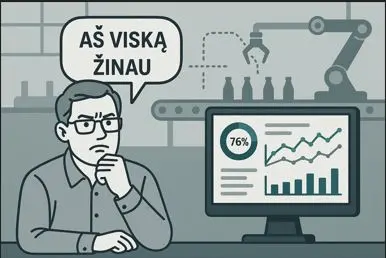
How does Lean2S MS change decision-making in manufacturing?
But as they say, in order to change the situation, you need to start with a personal change. So my manager's attitude - it will not be otherwise, the Lean2S equipment monitoring system will be used to see and evaluate more and more production indicators, the need to provide the manager with more accurate answers, based not on opinion but on numerical indicators and action plans, encouraged me to look for answers myself. This is exactly what is needed for a production efficiency analysis - to see all the shortcomings and trends in the process, which I could not see before, because I did not have the necessary tools for this. This is how the situation led to the realization that the "enemy" can become that solution, and the previously imagined shortcomings of the system - an opportunity to contribute to the development of the necessary tool, and thus the improvement of my operational process can be carried out.
By changing the attitude, the result also changed: it turns out that the Lean2S equipment monitoring system has more application possibilities than I thought, you just need to name exactly what I need from it. And the consultant of "UAB Proginta" seems so "uncommunicative", when I provide him with more detailed information about the processes, analyze the indicators, then the assumptions he makes turn out to be correct, and by using the advice, I can also find unexpected solutions and the production efficiency can be really better.
Also, disruptions in the work process, downtime and the fact that everyone can see them are not a shortcoming or an accusation against me or my team, but an opportunity to accurately name the causes of the problems and find solutions faster together with other departments. After all, it is also important for technicians that there are no technical equipment failures and that the production process is not disrupted.
And the team of employees also contributed to the change when they saw that specific progress indicators are not the enemy, but an opportunity to more accurately assess and show managers the results of their work. What is more, the operators themselves can directly name downtime, failures and other factors that prevent them from achieving results. This way, there is no “broken phone” left when the manager collects information to pass on to others.
Now I only watch with admiration and a slight smile other managers and companies who, using the Lean2S equipment monitoring system and the company's support, experience the same “shock” of change, throw away similar old beliefs in the trash and enjoy the achieved personal and team results. I hope that there will be more and more such experiences and I will be able to contribute to at least some of them.
Valdas Bindokaitis,
Change moderator