
Anyone who works in sales knows that storytelling and narrative presentation greatly help and create a lot of value. For some, this ability is more refined, it comes almost naturally, while others are less skilled at it. But once you know how to do it, that ability cannot be taken away. One aspect is that we use this ability to persuade others, but we also often don't realize when it first affects ourselves. This is precisely why this competence has a harmful side – we start to 'tell ourselves stories', stop using data and facts, and decision-making becomes based on our beliefs.
On one hand, this storytelling ability in production is beneficial for better communication: between managers and employees, for raising motivation, generating ideas, and creativity. On the other hand, when we talk about the production process, results, and efficiency – it becomes a drawback and an obstacle.
Assumptions and quick conclusions are formed in our minds, and aspects of stories that confirm them are found, leading to actions that may unfortunately be erroneous. "We've already tried that," "We've done it, it doesn't work," "There's nothing new here, we know everything," "It happens like that because...," "We always do it this way...," "I know, but I can't do anything..." – have you heard and probably used these phrases and thoughts?
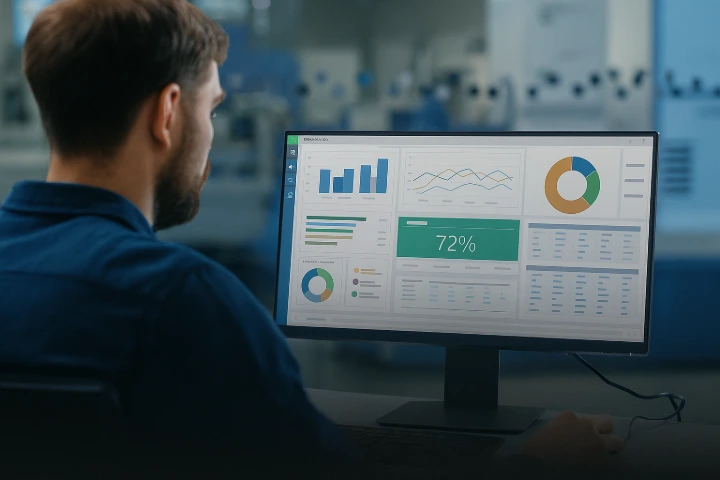
What is that filter?
We can confidently call it a certain filter, which consists of:
- Personal and othersopinions(often preconceived) about situations, actions taken or not taken by others, and their reasons.
For example, "Production does not follow instructions, does not check quality, does not adhere to the work schedule, works slowly" – a commonly held opinion regarding the production department.
- Beliefs – that processes, situations happen exactly as we, or others who tell us about it, imagine. This aspect becomes a significant drawback when we do not accept the possibility that it could be entirely different.
For example, a commonly held belief: "We can't produce because the equipment is constantly breaking down." Then this leads to the technicians' reaction and assessment: "The equipment breaks down because production does not provide the opportunity to perform repairs and maintenance when needed." Are these really the root causes and direct connections?
- Personal assessments– we are different, so it is natural that we have various assessment scales. Here arises the need for agreement, which is difficult to achieve when using different information and also opinions and beliefs.
For example, "A good result is when the line operates at X speed – it produces the required amount." "No, it is good when it operates slower, then we have a quality product, even if it is less." Who is right?
- Speculations – the first reaction and action when you lack information. Why did the work disruption occur, and how long did it last? Probably...(personal experience, common cases, assessment, beliefs).
Another speculation, or rather misleading information, when simply due to the high pace and flow of information, we do not remember what happened, do not track it in detail, so later we cannot accurately identify – creativity begins.
For example, the operator records their work in a log, work sheet, or similar, as well as failures and other cases. When a failure or disruption occurs, the first task is to restore the production process, and they pay the least attention to the clock or marking things down. They also cannot record all the work. And when information needs to be provided later, not everything is remembered, and then creativity is employed. Managers make incorrect assumptions and actions based on such information, and then the question arises: why does the result not change, even though actions are being taken?
- Experience and knowledge – is a very necessary competence to solve specific situations and problems (eliminating failures, organizing the production process, etc.). But it becomes an obstacle when this competence is applied as an explanation and justification for the situation, such as "we can't do it any other way," "it's always been this way," etc., and eventually turns into beliefs that lead to ineffectiveness.
- Manual data recording– there is essentially nothing wrong with that, provided that the data is always recorded on time and is accurate. The problem arises due to the human factor, as not all events can be recorded in time or accurately identified, and of course, the operator's personal assessment also contributes to this.
How is everything really?
And now let's look at all situations without this filter:
- The planned production result was not achieved due to process disruptions, the main three causes being A, B, and C according to their impact. The causes are identified according to clear rules (without discussions), if necessary - with additional information, with minute precision in the process log.
- The recording of process disruption is automatic and unavoidable - the employee only needs to identify the causes. Thus, there is no discussion left when the fact is recorded.
- We see that the biggest impact on the production process during this period was not failures (removing the belief, I would say one of the main ones), but for example, the lack of raw materials at the machines, i.e. a consequence of logistics work. Immediately, without additional speculation or opinions, based on the data, we all focus on this issue, as addressing it will show a significant improvement in the results of the production process.
- The production line is often stopped due to product quality aspects – a signal to the technologists and the quality department that more attention needs to be paid here. And if it is due to the quality of raw materials – a signal to the responsible supply chain manager.
- We see when the equipment failure occurred, how long the removal took. Is a similar failure happening for the first time? What needs to be changed in the equipment maintenance process? And if we have strengthened equipment maintenance – let's evaluate what impact it has on production results.
- Real situation:One operator works on the production line by setting a higher speed, which he believes is the maximum limit, as long as no disruptions occur. This is understandable since a bonus is received based on the amount produced. Meanwhile, another operator on the same line during a different shift works at a slower speed because, according to him, he does not want to "produce defects." At first glance, it seems in the company's interest that it would be more beneficial for everyone to work at a higher line speed. However, upon reviewing the long-term monitoring system Lean2S data, it becomes clear that the operator working at a higher speed also has significantly more "Defect Repair" downtimes, as well as more frequent equipment jams and failures. Meanwhile, the second operator set too low a speed, which resulted in him receiving a smaller bonus. Based on this, a constructive conversation with the operators could be conducted. Based on the collected data, an optimal line speed was established, which both agreed upon (one had to reduce the speed, and the other had to increase it). After a short time, technicians were able to assess the results of such a decision in terms of the equipment's technical condition and performance.
- Operators identify noticeable equipment problems, everyone sees (is recorded) how quickly responsible individuals react to this, whether the observations are resolved, and what the consequences are if there is no response.
- The main production machine has been down for 30 minutes (downtime). Everyone sees this (from operators to the director). How quickly will the situation be resolved compared to when there is no monitoring system and it operates on the principle of "we can see everything anyway"? And what if it immediately shows how much profit the company has lost?
Lean2S shows what the real situation in production is and not just that
Based on long-standing practice, I can confidently say that the discussed 'filter' is present in practically all manufacturing companies. Some acknowledge this and actively seek solutions to eliminate that effect, while others need help first to overcome their beliefs and preconceived notions about the method and tool itself.
When monitoring data is presented, there can be various reactions in companies – from joy that we finally see everything the same way, to dissatisfaction or even denial of the data, especially if previously 'smoothed over' aspects of production process disruptions become apparent. Yes, there are such cases, but the goal is singular – to eliminate the root causes of process disruptions based on real data and achieve a better result, visible in the company's bottom line.