
Ar visada daugiau yra geriau - ką atrodo Ringelmanas?
Production managers often say: "We have a strong team - everyone works, everyone tries."amybos vadovai dažnai sako: „Pas mus komanda stipri – visi dirba, visi stengiasi.“
But does each team member really put in as much effort as they could and are situations really managed in the most effective way? Or does it just seem like everyone is working because “there is movement”?
The Ringelmann effect, known in psychology, shows that the larger the group, the smaller each individual’s personal effort. This was confirmed as early as the early 20th century, when French engineer Maximilien Ringelmann conducted experiments with tug-of-war, weight lifting, and other team tasks. The logic was simple: each participant’s personal maximum result was recorded, then the participants were combined into groups of various sizes (two, four, eight, etc.). It was expected that the total result (e.g., the total weight lifted) should be equal to or even greater than the sum of the individual results, because it is believed that teamwork allows you to achieve more. This was thought 100 years ago, and it is still a popular idea today.
However, the results were unexpected: the more people pulled the rope, the lower their individual strength. The more people lifted the weight together, the less they lifted (for example, a group of eight people lifted only 49% of what they could achieve individually). The more people in the group, the lower the individual effort.
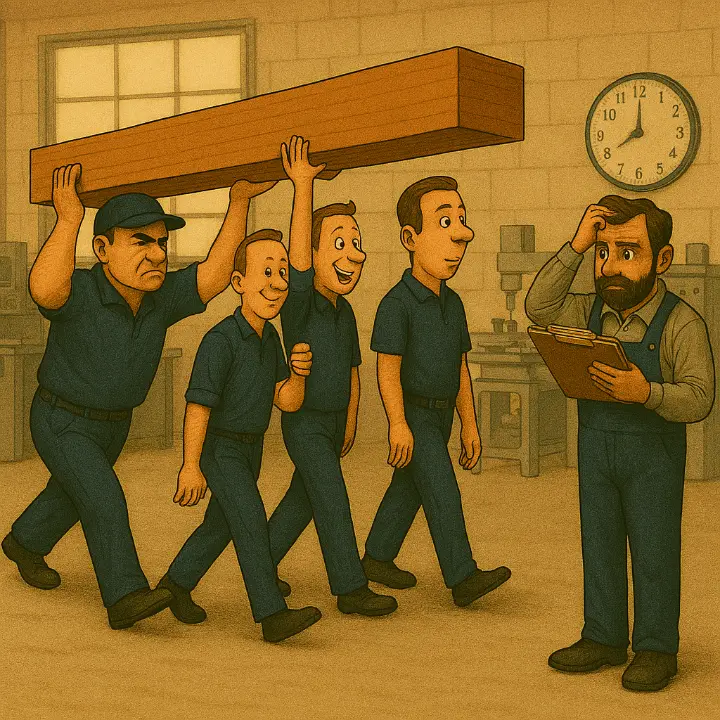
Why does this happen?
- Loss of motivation - when a person feels that his contribution is "drowned" in the overall result, he naturally puts in less effort. A person, consciously or not, always records how much effort he put in. If the result is achieved - next time he will put in the same amount - or less.
- Distribution of responsibility - "if I rest a little, no one will notice". And if there are many of us - maybe I will "drown in the crowd". If something goes wrong - I will also "suffer" not only one.
- Lack of coordination - a larger group often means poorer synchronization of actions, which reduces productivity.
- Social laziness – when people work in a group, they tend to put in less effort than when working alone. Even a seemingly innocent conversation with a colleague can reduce productivity.
This effect occurs not only in laboratories, but also in real production.
When working alone, a person knows: everything depends on me. In a group, responsibility becomes shared, which means that you can “relax a little.” This is how passivity is formed, which over time reduces efficiency. And this is not always visible to the naked eye – especially when managers are not around.
A specific case in production – the situation prompted managers to decide that in order to achieve a better result, the team needed another employee (a forklift driver who would bring in raw materials, pack and take out production). And the whole team held that opinion – because it really seemed logical. A change was made, an employee appeared. But the monitoring system showed that the use of the main unit’s working time, and even the work process itself, unfortunately, did not change at all. The decision was made to refuse the additional employee and work as before (although the process itself could be managed).
The work shift changes and employees have to pass information to each other. Someone comes to the workplace even earlier because of this, so that they can talk to their colleagues. But somehow the work is not more efficient at that time, but even “stops”.
We “put” additional employees at the line to “do it faster”, but the result hardly changes. An additional employee comes to help, and now “they just talk to each other”.
Are these situations familiar to you? Yes, yes - it’s all about the same thing.
It should be noted that no matter how much we talk about the advantages of teamwork, there are still no social technologies that would allow us to overcome the Ringelman effect.
Gamyboje tokią situaciją visgi galima suvaldyti su Lean2S
The Lean2S equipment monitoring system helps to see this situation clearly. It records:
- how long the device actually works (produces a product),
- when and how long downtime lasts,
- how the work pace changes,
- how different employees work at the same workplace.
And what you measure, you can influence and change. This is not control - it is transparency. When data is visible to everyone, self-control occurs. Employees know that their contribution is visible, and this motivates them. Managers see where the process is stuck, and can make decisions based on facts, not guesses.
- The manager no longer needs to guess why the shift result is worse - the data shows where and when downtime occurred, what caused them.
- The foreman no longer needs to "be there" for the team to work - Lean2S data acts as a mirror of transparency.
- The operator has the opportunity to show his contribution - not only to be at the workplace, but also to prove that he works efficiently. What's more, it's an opportunity to show real process obstacles and their impact on the result, and to suggest solutions.
- For the HR department, it's an opportunity to objectively assess employee engagement and competencies.
📈How does this help overcome the Ringelman effecasst?
- Individual responsibility – when the results of each workplace are visible, the illusion of “shared responsibility” disappears. Both individual (device/workplace) and collective (team, shift, workshop) results are visible.
- Data transparency – everyone sees the same thing, so discussions become constructive, not emotional.
- Motivation – when an employee sees that his efforts are visible and appreciated, how his specific actions affect the result, he tries harder.
- Change management – when new methods or work organization solutions are introduced, their impact is immediately visible – not only to the manager, but also to the entire team.
Lean2S equipment monitoring system helps you not only see, but also change.
Not just observe, but also involve.
Not only analyze, but also act.
If you feel like the team is working but the results aren't growing, it might be the Ringelman effect.
And maybe Lean2S can help you overcome it – not with theory, but with practical data.
Valdas Bindokaitis,
Change moderator