
Most manufacturing equipment service teams struggle to prove their worth – even when they do everything right.
This often results in underpriced service contracts, complex negotiations, and missed opportunities to increase service revenue.
Technicians adjust equipment, replace worn parts, and solve minor problems before they become serious failures (preventive work). As a result, production runs stably and equipment can operate for a long time without stopping.
However, the customer often sees only one moment - when the equipment breaks down.
If production has been running for a whole week without any problems, this is often perceived as just normal. In this case, the stability created by the service company remains invisible.
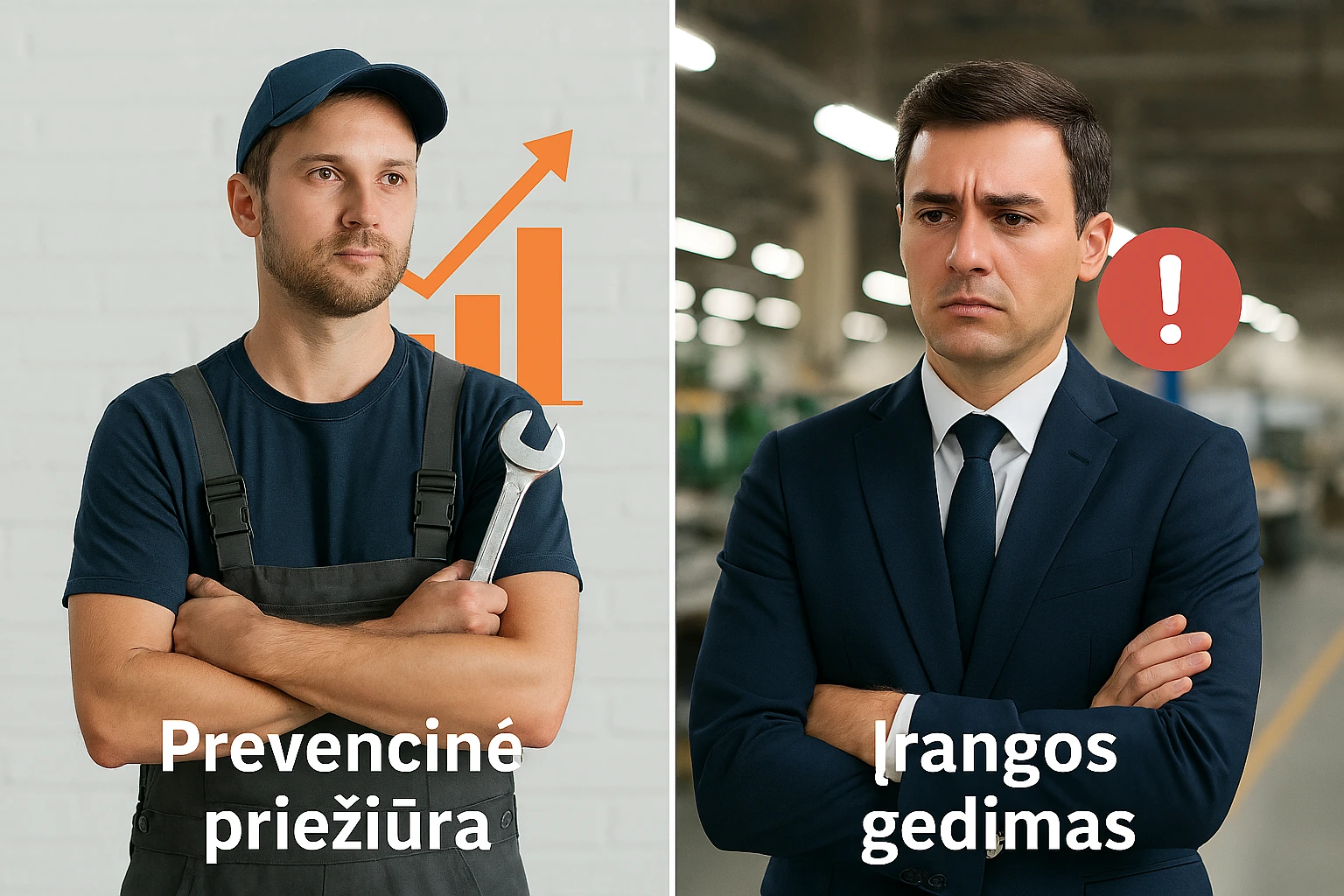
Why do service costs often seem like expenses?
In many companies, service costs are included in the cost line. When there is no objective data on the operation of the equipment, it is difficult for the customer to answer a simple question:
What real benefits have come from maintenance?
The service company itself can see:
- how many problems have been solved,
- how many failures have been avoided,
- how many times the equipment has been stabilized.
However, the customer often sees only the invoice for the work performed.
Without data on the stability of the equipment, the frequency and recurrence of failures, and downtime, the value and quality of service work remains difficult to measure.
Why aren't all downtimes equipment failures?
Downtimes in production are not only caused by technical failures, no matter how often production workers think and name them. You can read more about this topic in this article.
Equipment can stop or work slower for various reasons:
- production planning problems
- work organization principles
- operator work pace
- material supply problems
- quality assurance aspects
- technological process nuances, etc.
When these reasons are not clearly separated and named, downtimes are often attributed to equipment malfunctions.
In this case, a false impression may arise that the main problem is the technical condition of the equipment, although some downtimes occur due to other factors. And most often, such a "convenient" situation occurs that while attention is focused on technical issues, other areas are not analyzed. Only after troubleshooting begins, when downtimes decrease, do hidden problems begin to appear.
How can Lean2S help service companies?
The Lean2S production monitoring system allows you to see downtimes by their causes and clearly distinguish what is happening in production.
The system automatically measures equipment performance and allows you to see:
- downtime frequency
- downtime reasons
- equipment operating time
- equipment production quantities, completed cycles, engine hours,
- changes in equipment stability
When this data becomes visible, it is possible to objectively assess the result of equipment maintenance.
Lean2S provides indicators such as MTBF (mean time between failures) and MTTR (mean time to repair), which show how equipment reliability and repair efficiency change. Also MTBD (mean time between specific downtimes), which allows you to assess the recurrence of specific malfunctions and the situation after service work.
This allows the service company to show not only failures, but also how equipment reliability is improving.
Lean2S as an information source for service systems
Lean2S also helps improve the flow of information between production and service teams..
Operators can mark in the system:
- equipment failures
- observed failures
- reasons for discrepancies in working speed
- unusual equipment operation
- their observations and requests for necessary maintenance
This allows the service team to notice problems before they become serious failures and respond to the situation faster.
If the service company already uses its own notification or work management system, Lean2S can act as a data source. The system can transmit notifications about equipment events via API, so information about failures or malfunctions can be automatically directed to the already used service platform.
Most often, equipment maintenance is based on regular parameter checks (motor hours, cycles, units, etc.). For example, checking many moving units, bearing condition, oil change, lubrication of units, etc. Or it is simply performed with a certain repetition (e.g. every 3 months, or one annual preventive maintenance period is performed). The problem is that the load and intensity of operation of the equipment is either not assessed at all, or is assessed by calculating manually, i.e. there must be a responsible person who tracks when and what maintenance is required. Of course, there are now various IT systems, but they operate based on data entered by users and do not have direct data on the operation of the equipment. The Lean2S production monitoring system performs exactly this function.
In this way, Lean2S supplements the existing service infrastructure by providing real data on the operation of the equipment.
Data-driven preventive maintenance of equipment
Lean2S calculates the real production time of equipment, so preventive maintenance can be planned based on the actual hours worked.
This allows the system to:
- generate automatic reminders about scheduled preventive work,
- plan parts replacement based on equipment load,
- set maintenance priorities.
For example, if one equipment works much more hours than others, it may be the first candidate for preventive maintenance. Based only on the calendar work schedule (preventive maintenance is performed, for example, every month as a standard), it is possible that a less frequently used equipment does not need to be serviced as often, and this can save costs.
What does this mean for a service company?
When equipment performance is measured by data, a service company can more clearly demonstrate the results of its work. This provides three important advantages.
1. The value of service work is clearly visible
Data allows the customer to see how equipment reliability and downtime structure are changing.
2. It is easier to justify the need for preventive maintenance or new equipment
When failure intervals and equipment operating hours and load are visible, preventive work becomes based on objective data.
Also, by seeing the most loaded equipment, you can make a proposal to supplement the equipment base. Or, by seeing that equipment is not being used to its full potential, you can make proposals for automation solutions (for example, equipment is working slower than it could because manual loading/unloading is too slow - automatic solutions are needed to help use the available equipment more efficiently). This gives you an advantage over your competitors in your field.
3. Stronger long-term cooperation with the customer
The service company becomes not only a troubleshooting partner, but also a part of the reliability management of the equipment. Based on the equipment operating data, it can assess both the technical condition of the equipment and the need for repairs, and respond to situations faster.
Summary
A large part of the service work takes place when nothing bad happens.
That is why its value is often difficult to demonstrate.
You already have the data. You just don't see it or use it yet.
With Lean2S, we will show you what the equipment you service is really telling you, which will help you increase both the quality of your services and sales.
Is this relevant to you? Write to us and we'll discuss it in more detail 👇: